Thursday, January 25, 2007

Past Presidents of the College Hill Community Urban Redevelopment Corporation

  • 1976 Roy Hall
  • 1977 Roy Hall
  • 1978 Roy Hall
  • 1979 *
  • 1980 John Ludwig
  • 1981 John Ludwig
  • 1982 Don Hunt
  • 1983 Eve Bolton
  • 1984 Genevieve Kress
  • 1985 Kurt St. Clare
  • 1986 Genieve Kress
  • 1987 *
  • 1988 Eve Bolton
  • 1989 Ralph Galloway
  • 1990 Roy Hall
  • 1991 Eve Bolton
  • 1992 Eve Bolton
  • 1993 Eve Bolton
  • 1994 Brad Hammond
  • 1995 Brad Hammond
  • 1996 Andrew Lipton
  • 1997 Andrew Lipton
  • 1998 Michael Battoclette
  • 1999 Charles Darling
  • 2000 Barry Walker
  • 2002 Barry Walker
  • 2002 Gail Finke
  • 2003 Marty Weldishofer
  • 2004 Marty Weldishofer
  • 2004 Carol Lyon
  • 2005 Carol Lyon
  • 2006 Carol Lyon

We were unable to ascertain who was presidents in 1979 or 1987. If you know, please tell Carol Lyon (513-542-2942, carolilyon@aol.com)

Wednesday, January 17, 2007

A History of the Children's Hospital College Hill Campus

A glimpse of the Cincinnati Children’s College Hill Campus dating back more than 150 years


1848-1873

Ohio Female College

The Ohio Female College is one of the institutions that gave the community its name, College Hill, and its character as a center of learning. It was only the fifth college in the country to provide a liberal education for women.


College in 1852


The original campus had three buildings and 15 acres of woods and gardens. It was home to more than 250 women pursuing their interests in higher learning. The location was touted as being “central, accessible, elevated and healthy…and sufficiently far from the city to be free from its temptations and dissipating tendencies, yet near enough to enjoy its privileges.”


College in 1869


The main building was rebuilt after a fire in 1868. The college’s unique ventilating system was considered one of the first forms of air conditioning and gained much notoriety.


Rear view campus


There were flower and fruit orchards, a vegetable garden and a two-acre lake that fed from a natural spring which provided opportunities for rowing and ice skating. A stable was available for keeping horses.


The college could not afford to stay open and was sold to the Cincinnati Sanitarium in December 1873.


1873-1956


Cincinnati Sanitarium


“One of the largest psychiatric hospitals west of the Alleghenies,” the Cincinnati Sanitarium was founded by three physicians who recognized a need for a private care psychiatric facility in Cincinnati. They purchased the 40-acre property and transformed the buildings for the treatment of mental illness and alcohol and opium addictions.


Main campus


In addition to the main hospital, there were four two-story cottages, an amusement hall with a billiard hall in the basement, a flower conservatory, several physical plant buildings, an ice house and even a station for the Cincinnati Northwestern railroad.


Rest Cottage


In 1913 a nearby large residence adjacent to the property was purchased. Called the “Rest Cottage”, it was used in the care of individuals with “nervous and nutritional disorders”.


The grounds


The buildings were situated in the middle of a 30-acre park with fruit trees, shrubs, flowers, an artificial lake, gravel walks, a highly cultivated vegetable garden and a living spring. A major change in the landscape occurred in 1927 when the lake was drained.


1956-1994

Emerson A. North Hospital


In 1956, the Cincinnati Sanitarium was renamed for Emerson Arthur North, MD, a pioneer in clinical psychiatry at the University of Cincinnati. The 95-bed psychiatric hospital specialized in serving adults, adolescents and children in need of treatment for behavioral, emotional and chemical dependency problems.


During the 1960s and early 70s, Emerson A. North Hospital became part of the Cincinnati Mental Health Institute, serving as the inpatient component of the community mental health centers. A new facility was built in 1988 (Phoenix International). The hospital closed in 1994 when its services moved to Providence Hospital in Mt. Airy


1994-2000


Phoenix International


The campus was occupied for six years by Phoenix International, a company that conducted clinical trails of drugs for the pharmaceutical industry. The clinic closed after it was sold to another company and operations were consolidated.


December 2002


Cincinnati Children’s College Hill Campus


The Convalescent Hospital for Children generously provided the funding to purchase the Hamilton Avenue property and facility for Cincinnati Children’s Hospital Medical Center.


The Cincinnati Children’s College Hill Campus, which opened in December 2002, provides an extended hospitalization treatment program for children and adolescents who suffer from chronic mental illness and impaired functioning. An inpatient program also is offered at this location.

Thursday, October 26, 2006

"Where is it?" # 7


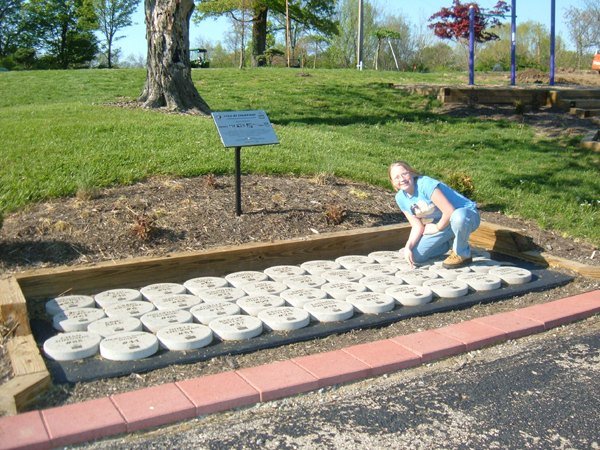
Did you know that there's an exercise course behind the College Hill Children's Hospital campus? It was made in part by players from the Bengals in a "Hometown Huddle" project.


These round pavers name all the players on the team that year.

Contributed by Gail Finke.

Wednesday, October 25, 2006

College Hill Business Association Unveils First in Series of Murals Created to Attract New Businesses to the Avenue

On Saturday, November 11 at 2 p.m., the College Hill Business Association (CHBA) unveils the first storefront mural in its Discover the Avenue fantasy business art project. The community-inspired art project will fill vacant storefronts on Hamilton Avenue with murals depicting the kinds of businesses College Hill residents want to see in their neighborhood. Painted by artist and College Hill resident Katie St. Clair, the first window, at 5838 Hamilton Avenue, depicts a "fantasy" ice cream shop.

The College Hill Business Association has as its goals to energize, revitalize, and market the business district. The College Hill Community Urban Redevelopment Corporation (CHCURC) and the CHBA have begun a marketing strategy using the theme Discover the Avenue. Foremost among the goals set by CHBA and CHCURC is attracting new businesses to the neighborhood.

The Discover the Avenue fantasy business art project will bring this stretch of Hamilton Avenue to life by putting art where it is hoped businesses will move in. "Why sit around and dream?" asks Phyllis Schoenberger, CHBA Secretary and Arts Project Coordinator, "If we get creative, maybe that dream will become a reality."

The effort was inspired by a successful project in Seattle, Washington, when the Columbia City neighborhood and the South East Seattle Arts Council had a half block of vacant storefronts painted to depict what was wanted and needed in the community. The murals captured the imagination of a developer and several business owners. Within a year, all murals had to be removed because "real" businesses wanted to locate there.

Discover the Avenue is the theme for each of the anticipated six storefront art projects. Each project will represent a business that was recommended in a 2002 market feasibility study or that residents have said they wanted. An ice cream store/bakery was at the top of the list of a recent resident and business survey of a "must have" business on the Avenue. New restaurants, entertainment venues, professional services and a personal service business followed in that order.

The first project is sponsored by Cincinnati Children’s College Hill Campus, Division of Psychiatry, which is currently undergoing an expansion of its College Hill Campus residential facility. Joan Burger, Outreach Coordinator from Cincinnati Children’s College Hill Campus stated "Cincinnati Children’s joined the College Hill community back in December of 2003. At that time, we had approximately 200 employees working at the College Hill Campus location. We are proud members of the College Hill Business Association and proud to support the community efforts to improve their neighborhood and business district. We are doubling in size by expanding our psychiatry services, adding on more outpatient offices, offering new employment opportunities and moving staff over from the Burnet Avenue location."

Katie St. Clair grew up in College Hill and is a College Hill resident. She graduated from the Art Academy of Cincinnati in 2005 as valedictorian of her class. She was recipient of the New York Studio Program and lived in New York City while participating in the Parsons School of Design Art Show. She then spent three months at the Academy of Fine Art in Munich, Germany, in a Munich Exchange Program. Her art work, her enthusiasm for the project, and her love for College Hill make her the perfect choice for the first project.

The second project, at 5923 will be supported and sponsored from Keep Cincinnati Beautiful. Linda Holterhoff and Robin Henderson from KCB are advisors on the project.

Thursday, October 05, 2006

"Where is it?" # 6


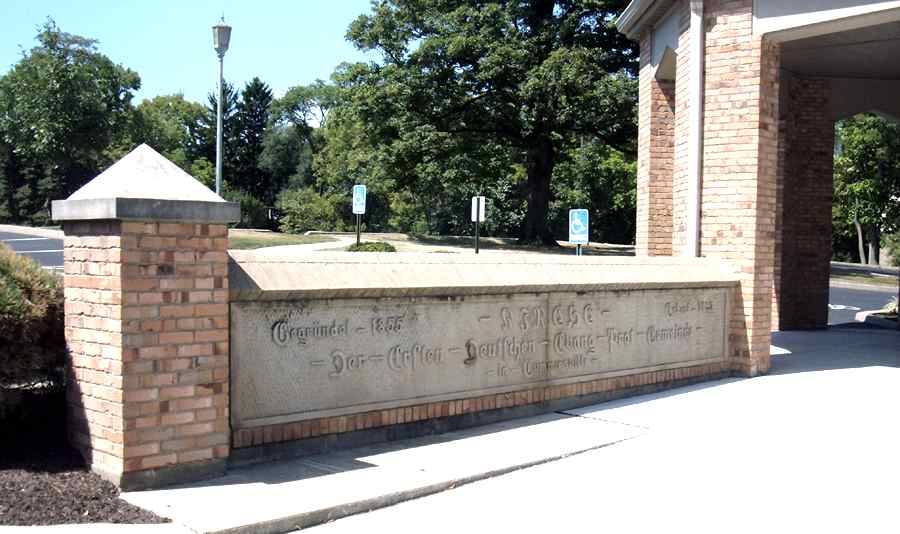
Those German Letters are on the "German wall" at the First United Church of Christ on Glenview. The church was located in Northside for many years. The inscription comes from the old building.

Wednesday, August 30, 2006

Stothers Concert Dedicated in Memory of David Schnaufer


Tom and Missy Strothers, College Hill, will dedicate their September 30 performance at the College Hill Coffee Company to David Schnaufer. David passed away on August 23. Donations will be accepted and given to a local hospice in David’s honor.

David Schnaufer, a musician who revived the use of the dulcimer in country music and taught the instrument to many students, died of cancer at a local hospice. He was 53.

Schnaufer recorded with The Judds, Johnny Cash, June Carter Cash, Kathy Mattea, Mark Knopfler, Emmylou Harris, Chet Atkins and many others on dulcimer, a gentle stringed instrument used in Appalachia since the 1800s, derived from zithers brought into North America by German immigrants in the 17th and 18th centuries.

"Anybody can make beautiful music in five minutes of playing the dulcimer," Schnaufer often said. "It's the simplest of all the stringed instruments, but can be as complex as anything else."

The Strothers who, have been playing dulcimer together since 2000 as a husband-wife duet, have been significantly influenced by the music, style and teaching of Schnaufer. In 2003, when Schnaufer was featured by the Cincinnati Dulcimer Society, the Strothers played their arrangement of Schnaufer’s composition "When Silence was Golden." After their performance Schnaufer in his usual Texas manner said, "It brought tears to my eyes."

It is appropriate to celebrate Schnaufer at the College Hill Coffee Company. David loved a good cup of java along with reading the NY Times. Recently Schnaufer was served an espresso. When asked how it was he replied with a thumbs up, "Fit for the Times." David Schnaufer was also fit for the Times along with newspapers and magazines coast to coast including Cincinnati where Schnaufer has inspired many musicians.

Details of the Strothers' tribute concert can be found at
http://www.collegehill-arch.org/calendar.htm .

Schnaufer had been an adjunct associate professor of dulcimer at Vanderbilt University’s Blair School of Music since 1995.

"David was one of the first teachers in the Blair School’s folk music program, along with Mark O’Connor and Butch Baldassari,” said Mark Wait, dean of Blair School of Music. "He was a wonderful artist and teacher, one whose influence will be felt for many, many years."

Schnaufer was born in Hearne, Texas, and grew up in La Marque, Texas. As a child, he experimented with mouth harp and harmonica. As a young man, he came across a display of dulcimers in Austin, Texas, and bought one for $40.

Schnaufer soon began winning dulcimer contests and moved to Nashville in the 1980s.
He progressed from playing in restaurants for tips to backing The Judds and other country music acts. He recorded and released solo dulcimer records and collaborations with other artists. For several years he was a member of the country-rock band The Cactus Brothers.
Wait recruited Schnaufer to the Blair staff after hearing him perform at a dinner party. Singer Cyndi Lauper was among his students.

"David was an amazing musician--that hardly needs to be said," Wait said. "But those of us fortunate to know him as a friend know that he was also an extraordinary and wonderfully generous human being. He treated everybody he worked with--students, colleagues, children, adults--with gentleness and respect. "

Services were held Saturday, Aug. 26, at 10 a.m. at Vanderbilt’s Dyer Observatory in Brentwood, Tennessee. Attending were the Strothers and two to three hundred friends of Schnaufer including recording artists such as Emmylou Harris, J. D. Crowe, and the Cantrells. Schnaufer’s brother, Reverend Eric Schnaufer performed the services. Wait delivered a moving eulogy – both humorous and poignant.

The ever present cicadas grew increasingly louder as Wait delivered the final remarks of his eulogy. Schnaufer loved the sounds of nature and included the sound of cicadas on his CD "Delcimore." The spirit of David Schnaufer was certainly present among those blessed by his life.


This article includes excerpts from the Vanderbilt News Service.

Thursday, August 17, 2006

"Where is it?" # 5

This interesting collection of stationary figures may be found on the east side of Oakwood Avenue right here in College Hill.


Wednesday, August 02, 2006

"Where is it?" # 4


A house built in 1821 once stood on this property that was later donated to the College Hill Presbyterian Church by the prominent Pounsford family. The house was then used for ministries and classes for many years, with this plaque near the road identifying its donors. In the 1980s the house was torn down for the construction of the Barnabas Center, the church's educational wing, but the memorial remains.


Idea and picture by Gail Finke.

Thursday, July 27, 2006

"Where is it?" # 3


This interesting scene can be found on the grounds of the McAuley Convent, which is on the north side of the west end of Cedar Avenue.

Thursday, July 06, 2006

"Where is it?" # 2


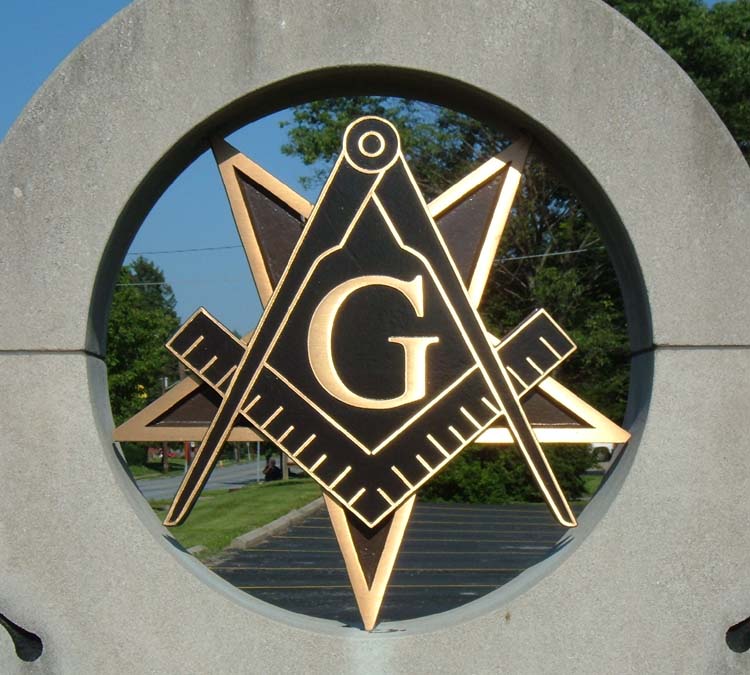
This symbol is on the site of the former Eastern Star Home on North Bend east of Hamilton.

It's the Masonic square and compass superimposed on a five-pointed star representing the star of Bethlehem.

See it soon, the property has been purchased by the city for use as part of the Linden Park development.

Idea and photo by Gail Deibler Finke.